What Is a Stat Block? How to Design Consistent Stat Blocks
A stat block is the fixed-format entry holding a creature's game numbers. How to design one for your own game: the fields, their order, and keeping fifty consistent.
By Munib Ali LaghariPublished 10 min read
A stat block is the fixed-format entry that holds everything a game master needs to run a creature: how hard it is to hit, how much damage it takes, how it moves, and what it does on its turn. Designing one means choosing those fields and their order once, then giving every creature the same shape.
On this page
This guide is for designers writing their own game or supplement, not for looking up a monster to run tonight. If you only need one block for one session, the section on generators near the end is the quicker route. We make RuleBindery, which appears in one section below; everything else works with whatever tools you already use.
What is a stat block?
A stat block is a compact, standardised summary of one creature's or character's game statistics, laid out so it can be read at the table without turning to the rules chapter. "Statistics" here means anything the rules need to resolve an encounter: defences, health, speed, special abilities and attacks.
The format is older than most of the games that use it. In the original 1974 Dungeons & Dragons, a monster's numbers sat in a single row of a table with six columns, including Armor Class, movement and Hit Dice, as Justin Alexander shows in his history of the stat block. By 2005, a forum member on EN World defined it in one line that still works: "A StatBlock is the stats of a particular creature or NPC to be used in your adventure".
Today the format carries a lot of weight. The 2024 Monster Manual has "over 500 total" monsters, and Wizards of the Coast says all of its creature stat blocks "have been redesigned and rebalanced for ease of use." Five hundred entries is exactly the scale at which a stat block stops being a writing problem and becomes a consistency problem.
What goes in a stat block?
A stat block holds the numbers and rules a game master needs to run the creature, and nothing they would have to look up elsewhere. Every game names these differently, but nearly all of them fill the same seven jobs.
| Job | What it answers at the table | D&D 2024 calls it | A homebrew game might call it |
|---|---|---|---|
| Identity | What is this, in one glance? | Name; size, type and alignment | Name and a one-line summary |
| Threat | How dangerous is it compared with others? | Challenge Rating (CR) | Rank, Tier, Level |
| Defence | How hard is it to hit or affect? | Armor Class, saving throws | Guard, Defence, Armour |
| Durability | How much does it take to drop it? | Hit Points | Health, Harm, Wounds |
| Movement | Where can it go this turn? | Speed | Move, Range bands |
| Traits | What is always true about it? | Traits | Traits, Features, Tags |
| Actions | What does it do on its turn? | Actions, Bonus Actions, Reactions | Attacks, Moves, Abilities |
The middle column comes from D&D Beyond's 2024 creature stat block rules. The right-hand column is illustrative; the point is that the jobs are the same even when the vocabulary is yours.
What a stat block leaves out matters as much. Lore, tactics and ecology belong in the prose around the block. A stat block that mixes in "the hounds were bred in the burnt mills of the east" is harder to scan, and that sentence will be duplicated every time the creature appears.
What order should a stat block's fields go in?
Put the fields in the order a game master needs them during a fight: identity and threat first, then the numbers checked every round (defence, durability, movement), then always-on traits, then actions. Whatever order you choose, it must be identical in every block.
The reasoning for that order is how a stat block gets read. Nobody reads one top to bottom at the table. A player attacks, and the GM's eye jumps to the defence number. Damage lands, and it jumps to health. It is the creature's turn, and it jumps to actions. Fixed positions are what make those jumps fast.
D&D's 2024 layout follows the same logic. Armor Class and Initiative come first, then Hit Points and Speed, then the ability scores in a table with their saves, then senses, languages and challenge rating, and finally traits, actions, bonus actions, reactions and legendary actions, according to the 2024 basic rules.
Two choices are worth making on purpose:
- Traits before actions. A trait often changes how an action works ("Hounds within reach roll attacks twice"). Reading the trait first means the action is understood correctly the first time.
- How much to explain in the block. Alexander calls this the "hierarchy of reference": deciding which abilities are spelled out in the block and which point to the rules. Stephen Bandstra of Dump Stat Adventures praises the 4th edition block because "everything you need to know about the monster is there". Our view: spell out anything unique to this creature, and reference anything shared by many.
How to make a stat block for your own game
To make a stat block, decide which statistics your rules actually use in a fight, fix their names, format and order in a short written spec, then fill that spec in for each creature. The spec is the part most designers skip, and it is what keeps creature number fifty matching creature number one.
- List what your rules check in a fight. Go through one combat round in your rules and write down every number or ability the GM looked up. That list is your field set. If a number never comes up in play, it does not belong in the block.
- Give each field one name, forever. "Guard" in the first block means "Guard" in every block, never "Defence" in chapter 6.
- Fix the format of each value. Decide whether health is a flat number or a dice expression, and how an attack is written ("Bite +4 (2d6)"). Write one example of each.
- Fix the order. Use the order above, or your own, and write it down.
- Decide what lives outside the block. Lore and tactics go in prose. Shared rules get a reference, not a copy.
- Write three creatures that are very different, a weak one, a strong one and a strange one, and check that the spec handles all three without exceptions. If it needs an exception, fix the spec now.
- Then write the rest. Every new creature starts from the spec, not from copying the last creature you wrote.
A stat block spec you can copy
This is the spec behind the example creatures in this post, from a made-up game. Replace the field names and formats with your own; keep the shape.
STAT BLOCK SPEC: Ashfall (example game)

Order:   Name, Summary, Rank, Guard, Health, Move, Trait (0+), Attack (1+)

Name     Title case, singular.           "Ash Hound", not "Ash Hounds"
Summary  One sentence: what it is.       Italic, under 15 words
Rank     Whole number, 1-10.             Threat compared with other creatures
Guard    Whole number.                   The number an attack must beat
Health   Whole number, never dice.       "18", not "4d8"
Move     Speed bands, comma-separated.   "Near, climbs"
Trait    "Name. One-sentence effect."    One line per trait
Attack   "Name +bonus (damage)"          One line per attack
Applied to a creature, that spec produces this:
Ash Hound
A soot-grey hunting dog bred by the cinder cults.
Rank: 2
Guard: 13
Health: 18
Move: Near, climbs
Trait: Smoke-blind. Can't see through its own smoke.
Attack: Bite +4 (2d6)
How to keep fifty stat blocks consistent
Consistency comes from treating each stat block as a record with fixed fields, not as a formatted paragraph, and from keeping one master copy of each creature that every page uses. The written spec fixes the fields; the single master copy stops the copies drifting apart.
Most consistency problems are not bad design. They are copies. The same creature appears in the bestiary, in an adventure and in a quick-reference sheet. A playtest changes its health from 18 to 22. Two of the three copies get updated. That pattern is what our post on why one rule change breaks a finished layout walks through in detail.
Three habits prevent it, whatever tool you use:
- One master copy per creature. Every other appearance points to it, in the same way a cross-reference points to a page rather than repeating it.
- Check names, not just numbers. "Ash Hound" in the bestiary and "Ash-Hound" in an adventure will both survive a proofread. Search for each creature's name and look for near misses.
- Re-check the spec at every playtest round. If a new creature needed a field the spec does not have, add it to the spec and to every block, or drop it.
Stat blocks are one part of the structure of a rulebook. Our guide on how to make a TTRPG rulebook covers the rest, from section order to the checks before release. For the chapters themselves, our TTRPG rulebook template is a free outline with an adversaries chapter ready for stat blocks.
How RuleBindery handles stat blocks
In RuleBindery, each creature is an entry in the project's library, with its stats typed one per line as "Name: Value". Every copy of the creature in your book is drawn from that one entry. We checked each of the claims below in the app on October 21, 2026, on a Free account.
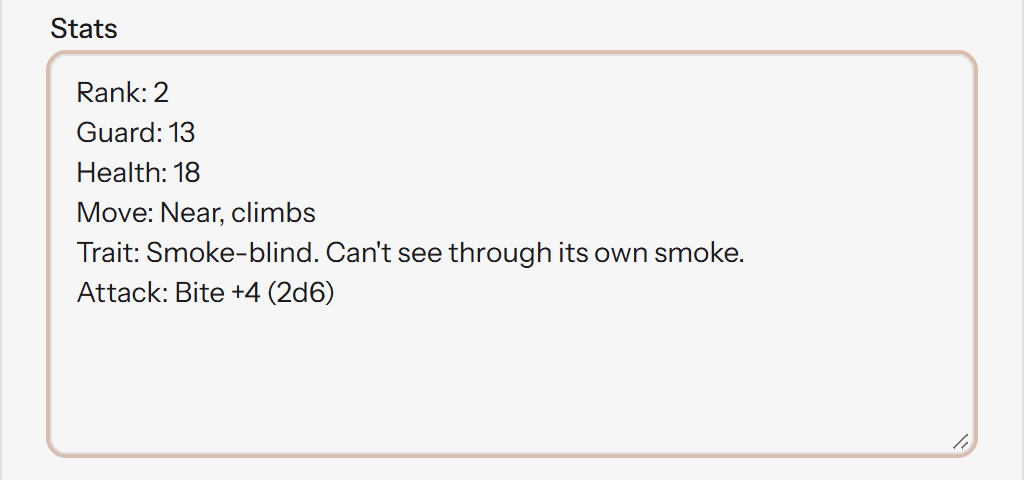
The stats appear on the page in the order you type them, and a name can repeat, so a creature with two attacks gets two "Attack" lines. Every monster entry is drawn with the same layout, so the block for creature fifty matches the block for creature one.
Then we put the Ash Hound in two places, the bestiary and an encounter, and made one edit in the library: we renamed it Ember Hound and changed its health from 18 to 22.
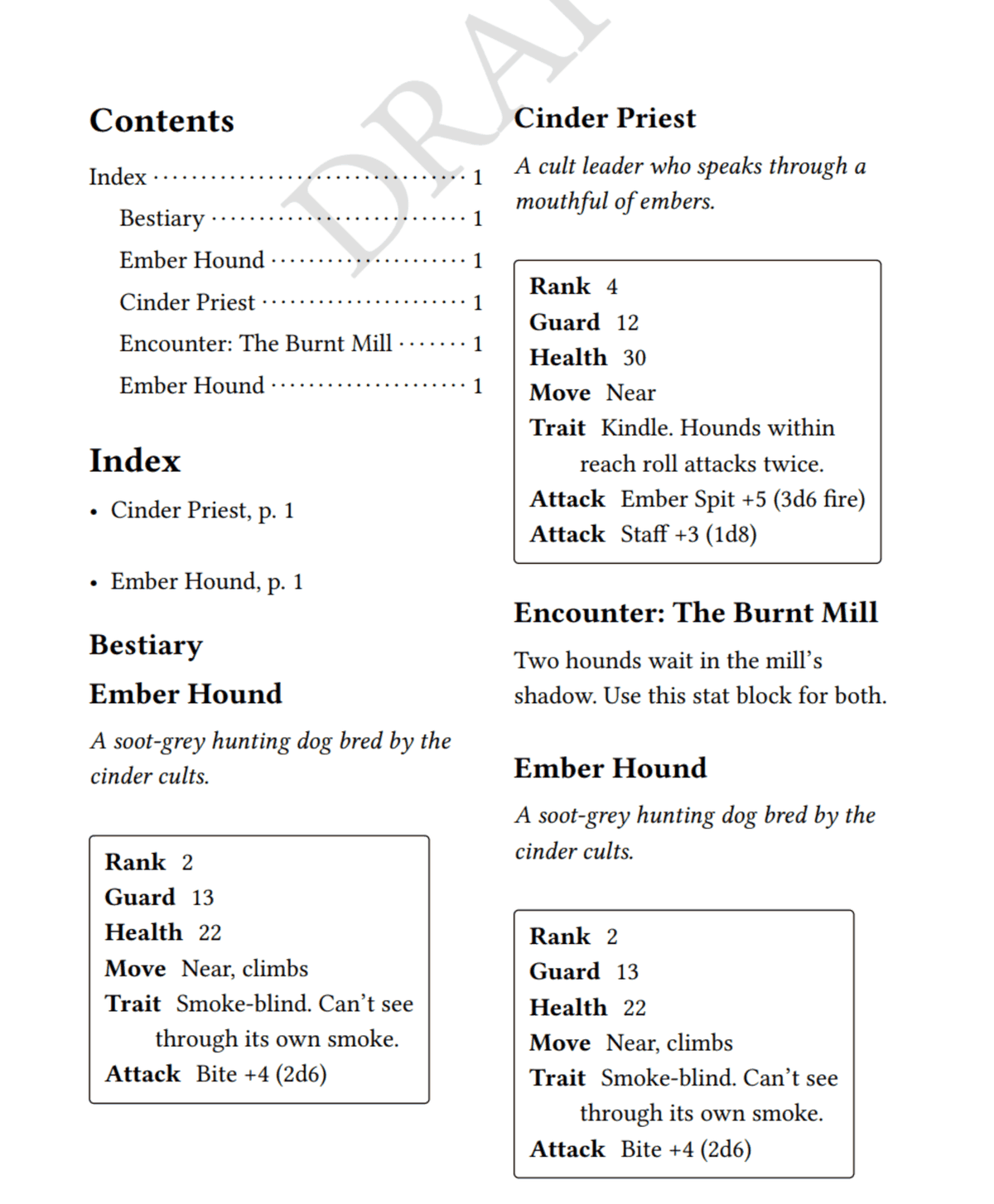
Both stat blocks, the contents and the index changed together. Nothing was retyped.
RuleBindery also has limits worth knowing:
- It does not force every creature to have the same stats. A monster entry takes whatever stat lines you type, so the spec above is still your job. What RuleBindery does catch is two names a letter apart, such as "Frost Veil" and "Frost Vail", which our rulebook guide shows in a screenshot.
- It is not a hand-placed design tool. If the look of each stat block is the point of your book, Affinity or InDesign give you visual control that RuleBindery deliberately does not.
- It is built for whole books, not one-off monsters. For a single creature for Saturday's game, the generators below are quicker.
Writing, structuring and checking a book, including the watermarked draft PDF shown above, are on the Free plan. The pricing page lists what each plan adds.
Should you use a stat block generator?
Use a generator when you need one D&D 5e stat block quickly; use a written spec and a structured source when you are designing a game or a book with many creatures. Generators are fast and free, but they are built around one game's format and produce one block at a time.
Two well-known free options, both for D&D 5e:
- Monsterbrew describes itself as "a free, browser-based monster statblock builder for D&D 5e", built for the 2024 rules. It exports to Homebrewery markdown, Foundry VTT, PDF and PNG, among others.
- Tetra-cube's D&D 5e Statblock Generator is based on Statblock5e and Open5e, and can save, load and show a block as an image or as markdown.
If your game is not D&D, or if the same creature will appear in several places, a generator's output is a one-off copy. That is exactly the kind of copy the consistency section above warns about.
Frequently asked questions
What is a D&D stat block?
A D&D stat block is the standard entry for a creature in Dungeons & Dragons. In the 2024 rules it lists Armor Class, Initiative, Hit Points, Speed, the six ability scores with their saves, senses, languages and Challenge Rating, followed by traits and actions. D&D Beyond's creature stat block rules show the full layout.
How do you make a stat block?
List the numbers your rules check during a fight, give each one a fixed name and format, put them in a fixed order, and write that down as a short spec. Then fill in the spec for each creature, starting from the spec every time rather than from the last creature you wrote. The seven steps above go through it in order.
Is a stat block the same in every RPG?
No. Each game decides its own fields, names and order: D&D uses Armor Class, Hit Points and Challenge Rating, while other games use their own terms and often far fewer numbers. What stays the same is the job a stat block does, which is putting everything needed to run a creature in one place, in the same shape every time.
What is the difference between a stat block and a character sheet?
A stat block is a compressed, read-only summary for the game master to run a creature in play. A character sheet is the full working record a player keeps and updates for their own character, including equipment, notes and everything that changes between sessions.
Should a stat block ever split across two pages?
Avoid it whenever you can. A game master who has to turn a page in the middle of a fight loses their place, which defeats the point of having a stat block at all. If a block is too long to fit, that is usually a sign it includes something that belongs in the prose around it.