What Is an SRD? System Reference Documents in TTRPGs
An SRD is the part of a tabletop RPG's rules released under an open licence for others to build on. What one contains, what it leaves out, and the main examples.
By Munib Ali LaghariPublished 10 min read
An SRD, or System Reference Document, is the part of a tabletop roleplaying game's rules that its publisher releases under an open licence, so that other designers can build compatible games and supplements. An SRD contains mechanics rather than the game's setting or art, and it always comes with a licence that sets the terms of reuse.
On this page
This guide is for designers: people building on someone else's SRD, and people wondering whether their own game should have one. It covers what an SRD contains, what it leaves out, how it differs from the licence, and the SRDs you are most likely to meet. Licences are legal documents, so treat this as general information, not legal advice. We make RuleBindery, which appears in one section near the end.
What does SRD stand for?
SRD stands for System Reference Document. In tabletop games the term means a game's openly licensed rules text. Outside games the same three letters mean other things, such as a software requirements document or the currency code of the Surinamese dollar, which is why a search for "SRD" turns up so much that has nothing to do with games.
"System" here means the game's rules engine: how you roll, how characters are built, how combat resolves. "Reference" means it is written to be looked up, not read cover to cover. An SRD usually reads like a rulebook with the friendly parts taken out.
What is an SRD in D&D?
In Dungeons & Dragons, the SRD is the subset of the rules that Wizards of the Coast publishes for anyone to reuse, and it is where the idea started. The first one came out in 2000 alongside D&D's third edition, under the Open Game License, according to Wikipedia's history of the SRD.
The fifth-edition versions are the ones most designers use today:
| Version | Rules it covers | Licence | Published |
|---|---|---|---|
| SRD 5.1 | The 2014 rules | Creative Commons Attribution 4.0 (CC BY 4.0), and still the Open Game License 1.0a | 2016; placed under Creative Commons on January 27, 2023 |
| SRD 5.2 | The 2024 rules | CC BY 4.0 | April 22, 2025 |
| SRD 5.2.1 | The 2024 rules, corrected | CC BY 4.0 | May 1, 2025 |
The 2023 change ended weeks of backlash against Wizards' plan to replace the Open Game License. Wizards' announcement on D&D Beyond reported that more than 15,000 people had answered its survey on the draft replacement, and that 88% did not want to publish under it. The same post said Wizards was "leaving OGL 1.0a in place, as is" and "making the entire SRD 5.1 available under a Creative Commons license." The dates for 5.2 and 5.2.1 are from the SRD page on D&D Beyond, which also says "all new SRD versions will be released exclusively under Creative Commons."
What goes in an SRD, and what stays out?
An SRD holds the rules another designer needs to make something compatible: core mechanics, character options, spells, items and creatures. The publisher keeps back the material that makes the game recognisably theirs, such as named characters, signature monsters, the setting, the art and the book's design.
D&D's SRD 5.2 makes the line easy to see. D&D Beyond says some classes (the Artificer), species (the Aasimar) and monsters (the Beholder) "have been excluded", that "Names like Strahd, Orcus, and Tiamat won't appear in SRD 5.2", and that some entries were renamed "to avoid using protected trademarks."
Most SRDs follow the same pattern, with exceptions:
| Usually in an SRD | Usually kept out | Varies by game |
|---|---|---|
| Core resolution rules (rolls, checks, outcomes) | Setting names, places and characters | Lore and setting material |
| Character creation and advancement | Signature creatures | Optional and advanced rules |
| Spells, items, conditions | Art, maps and the book's layout | Example adventures |
| Generic creatures and stat blocks | The game's logo and trademarks | Material from later supplements |
The right-hand column is why you read each SRD instead of assuming. The Daggerheart SRD, for example, describes itself as covering "the rules, mechanics, lore, and content" for use under its licence, so lore is in. Many other SRDs leave the setting out entirely.
Is an SRD the same as a licence?
No. The SRD is the content, and the licence is the permission. An SRD tells you which rules text is available; the licence tells you what you may do with it, and what you must do in return, which is usually crediting the source in a specific way.
The two can come apart. SRD 5.1 is available under two licences at once, the Open Game License 1.0a and CC BY 4.0, and a creator picks one. Daggerheart's SRD uses a licence written for that game alone, the Darrington Press Community Gaming License. The ORC License, which Paizo published in its final form on June 30, 2023, works the other way round: it is a licence written for any game, and Paizo moved its remastered Pathfinder rules onto it.
A free rules website is not automatically an SRD, either. Necrotic Gnome offers a free online reference for Old-School Essentials, yet the site itself states that its material "is not open content and may not be copied, adapted, or remixed without permission". Free to read and free to reuse are different things, and only the licence tells you which one you have.
Well-known SRDs and their licences
These are the SRDs a designer is most likely to build on. We checked each on its publisher's own pages on October 22, 2026.
| Game | Current SRD | Licence | Worth knowing |
|---|---|---|---|
| Dungeons & Dragons (2024 rules) | SRD 5.2.1 | CC BY 4.0 | Some classes, species, monsters and names are excluded or renamed |
| Dungeons & Dragons (2014 rules) | SRD 5.1 | CC BY 4.0, or OGL 1.0a | Use the attribution wording in its own preamble |
| Daggerheart | SRD v2.0, August 25, 2026 | Darrington Press Community Gaming License | Includes lore, and the campaign frame mechanics from the core set and Hope & Fear |
| Pathfinder Second Edition (remastered) | Rules in the remastered core books | ORC License | Paizo finished moving its core game off the OGL in July 2024 |
| Fate (Core, Accelerated, Condensed) | Fate SRD, endorsed by Evil Hat | CC BY 3.0 Unported | Also hosts SRDs for older Fate versions |
| Blades in the Dark | Blades in the Dark SRD | CC BY 3.0 Unported | Gives exact attribution text to copy |
Versions change, and so do licences. Check the publisher's page on the day you start a project, and again before you release it.
Who uses an SRD?
Four kinds of people use an SRD, for different reasons:
- Third-party publishers write adventures, monsters and supplements that work with a popular game, without asking permission for each one.
- Designers of new games start from an existing engine and change it, instead of building every rule from scratch.
- Tool and app makers need rules text they are allowed to put inside software, such as a character builder or a virtual tabletop module.
- Players and game masters look up rules without opening the book. Many SRD websites exist for exactly this.
For the publisher, an SRD is an invitation. Every compatible product made by someone else is another reason for a player to pick up the original game.
How to use someone else's SRD
To use an SRD, read its licence before you write anything, use only the material the SRD actually contains, and copy the attribution exactly as the licence asks. Most problems come from skipping the first step.
- Read the licence, not just the SRD. The licence decides whether you may sell your work, whether you must share your own text under the same terms, and what you have to credit.
- Find the required attribution, and copy it word for word. Blades in the Dark's licensing page gives a three-part credit and asks for it at the same size as the rest of your copyright section. D&D Beyond says SRD 5.1 content "must use its attribution terms as specified in its SRD 5.1 preamble."
- Check every name against the SRD itself. If a monster or spell is not in the SRD, it is not covered by the licence, even if it is in the core book. SRD 5.2's renamed entries are an easy trap.
- Note what you changed. The Creative Commons BY 4.0 licence, in section 3(a)(1), asks you to "indicate if You modified the Licensed Material", as well as to credit the creator and link to the licence.
- Keep the credit with the material everywhere it goes. A credit page in the PDF does not cover the same rules pasted onto a website or into a virtual tabletop module.
Our view is that step 2 deserves the most care, because it is the one designers improvise. A credit that is almost right ("based on the 5e SRD") is still not the credit the licence asked for.
Should your own game have an SRD?
Your game should have an SRD if you want other people to make things for it, and if you can keep that SRD up to date. A community making adventures and hacks is the best marketing a small game can get. An SRD that disagrees with the current rulebook hurts more than having none.
The maintenance is the part people underestimate. Every errata pass, every rebalanced number and every renamed term has to land in two places: the book and the SRD. If the SRD is a separate copy, the two drift apart, in the same way a stat block copied into three chapters drifts apart (our guide to designing consistent stat blocks covers that problem). The more your game changes after release, the more an SRD needs to come from the same source as the book.
How RuleBindery exports an SRD
RuleBindery builds an HTML SRD from the same project as the book. You choose which documents go into the SRD, and it takes the library entries those documents use. Each library entry can point to a licence entry, and that licence is printed on every page of the export. We checked everything below in the app on October 23, 2026, on a Publisher account, with a small sample game called Ashfall.
Ashfall has two documents: the combat rules, which are open, and a chapter on the game's cults, which is not. On the export screen, the cults chapter is simply left unticked. The choice is saved with the document, so the next export, after an errata pass for example, contains the same documents.
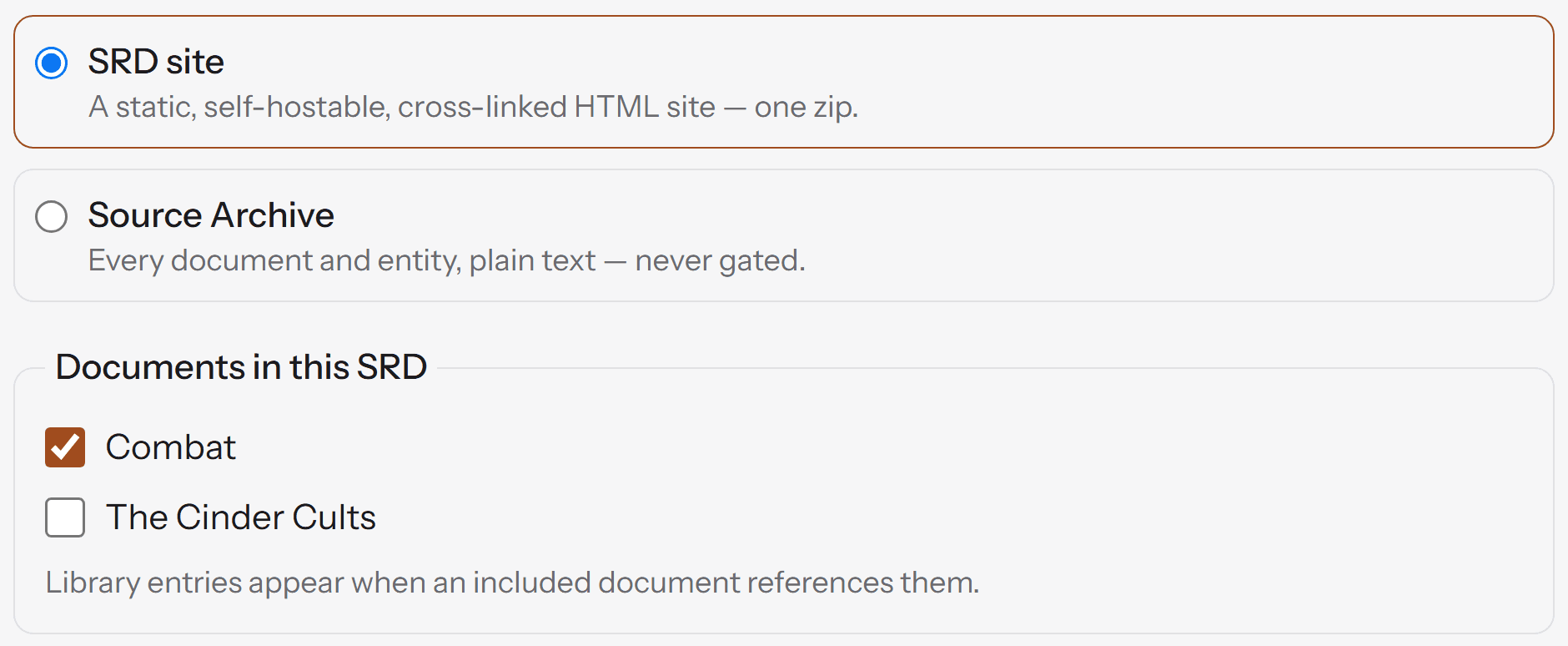
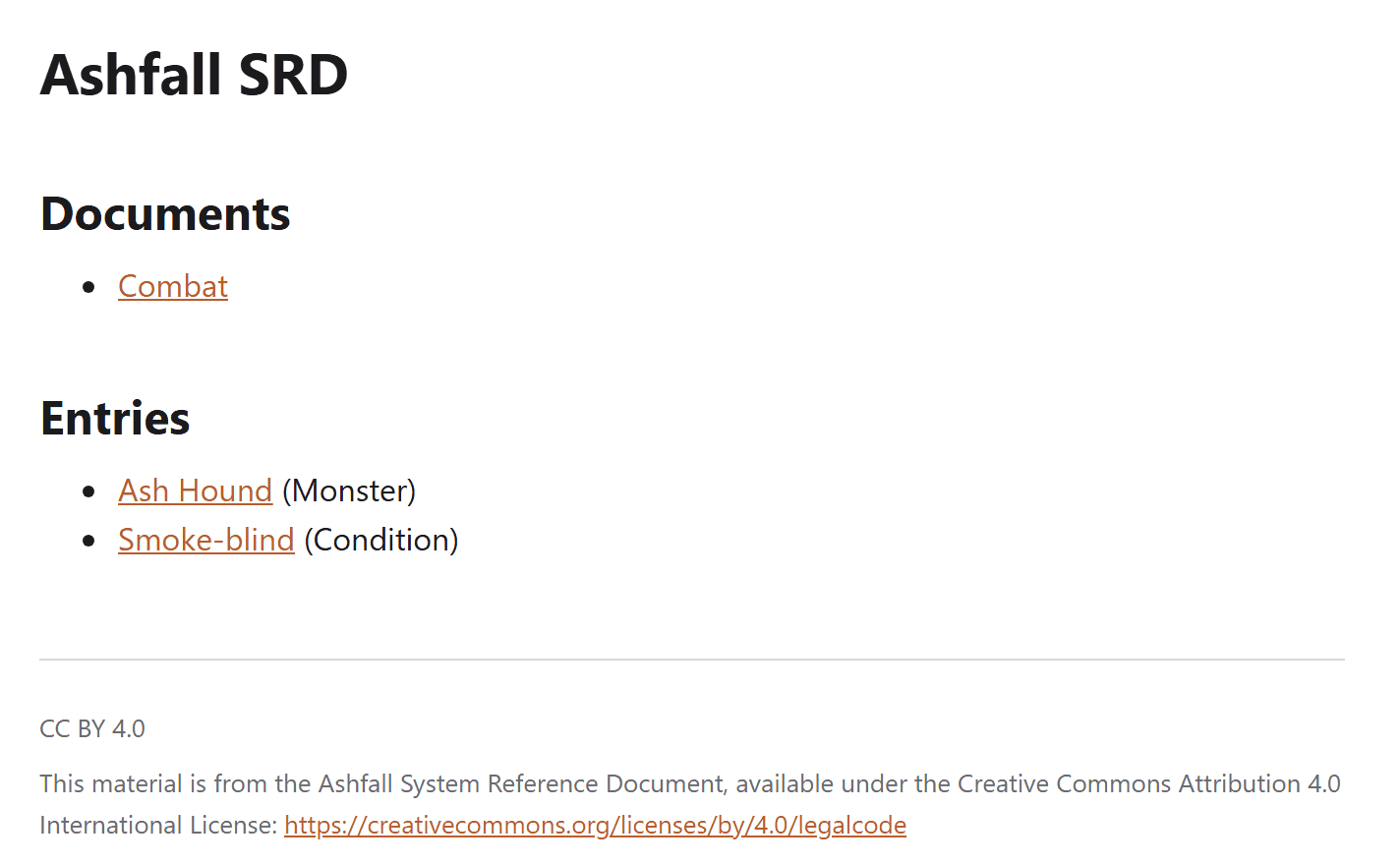
The export is a zip file holding a small static website: a contents page, one page per included document, one page per library entry those documents use, a stylesheet, a LICENSE.txt file, and a manifest that records what went into the export. Upload the folder to any web host that serves static files and the SRD is online.
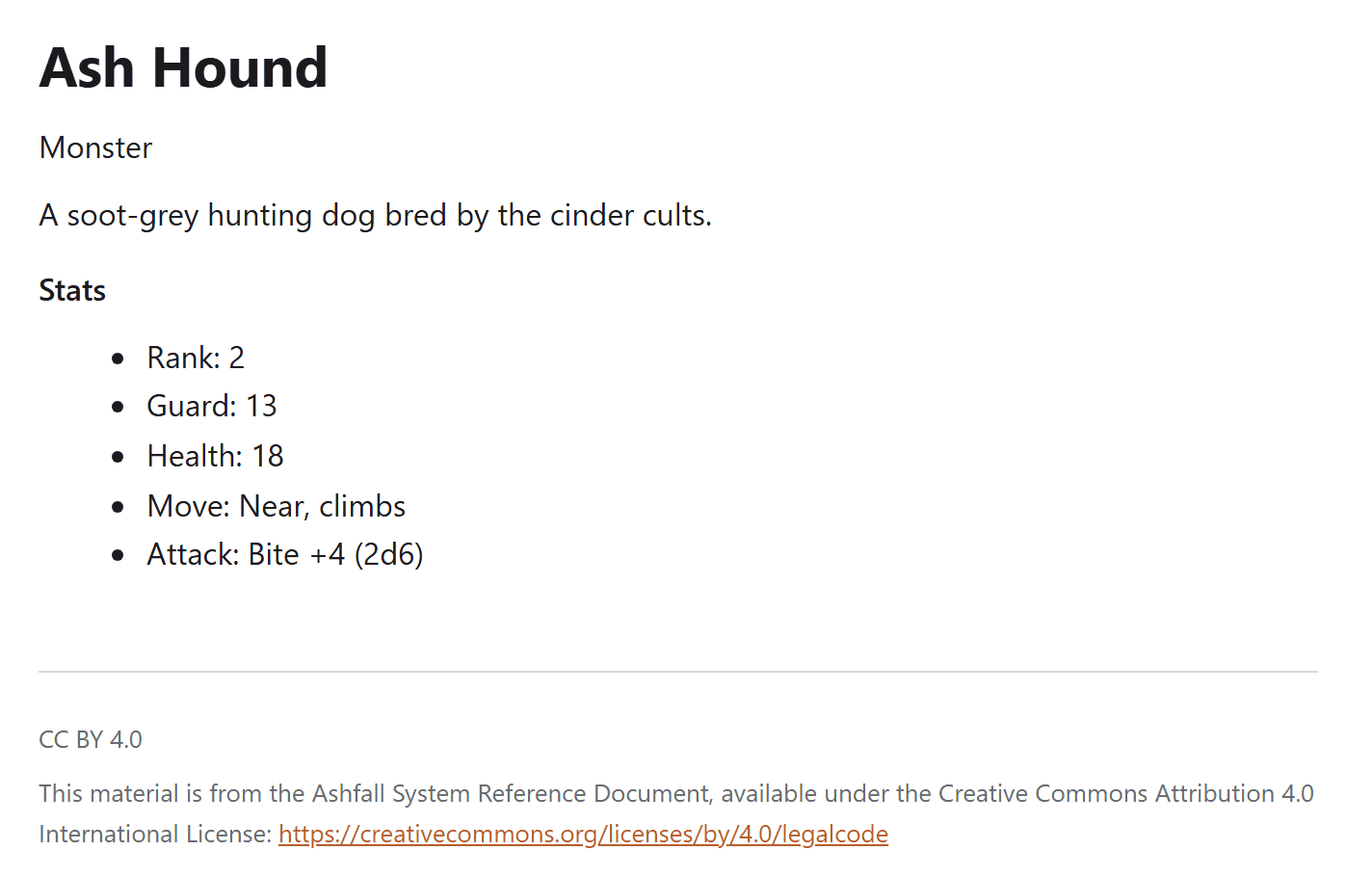
A reference in the rules text becomes a link to that entry's own page, so a reader can follow "Ash Hound" from the combat rules to its stats.

Because the SRD and the book come from one project, a rule changed in the library changes in both the next time you export.
The export also has limits worth knowing:
- Entries follow the documents. A library entry appears in the SRD only when an included document mentions or embeds it. An entry that sits in the library but appears nowhere in the text stays out, so put it in the text if it belongs in the SRD.
- The pages are plain. The SRD uses a simple, readable stylesheet with a dark mode, not your book's design. If the look of the SRD matters, you will be restyling it yourself.
- RuleBindery does not choose your licence. It carries whatever licence text you write into each page. Which licence you use, and what it requires, is still your decision.
The HTML SRD export is part of the Publisher plan; writing and structuring the rules is on the Free plan. The pricing page lists what each plan includes. For the rest of the work of turning a draft into a finished book, see our guide on how to make a TTRPG rulebook.
Frequently asked questions
What does SRD stand for in D&D?
In D&D, SRD stands for System Reference Document: the part of the Dungeons & Dragons rules that Wizards of the Coast lets anyone reuse under an open licence. The current version for the 2024 rules is SRD 5.2.1, released under Creative Commons Attribution 4.0.
What is an SRD document?
An SRD document is the system reference document itself: the file or website that contains a game's openly licensed rules. It is usually published as a PDF, a website, or both, with the licence and the required attribution included.
Is an SRD free to use?
An SRD is usually free to read and free to build on, but only under the terms of its licence. Most licences ask for a specific credit, some forbid certain uses, and some free rules references are not open for reuse at all. Read the licence before you rely on it.
Can I sell content made with an SRD?
Under most open game licences you can sell compatible content, as long as you follow the licence's terms, including its attribution. The details vary: some licences limit which names, logos or compatibility claims you may use. Check the specific licence for the SRD you are building on.
What is the difference between SRD 5.1 and SRD 5.2?
SRD 5.1 covers the 2014 Dungeons & Dragons rules, while SRD 5.2 covers the 2024 rules and uses their updated wording. Both are under CC BY 4.0, and SRD 5.1 is also available under the Open Game License. Compared with 5.1, SRD 5.2 adds 15 feats, 20 spells, 15 magic items and 17 monsters, according to D&D Beyond's SRD page, and renames some entries to avoid trademarks.